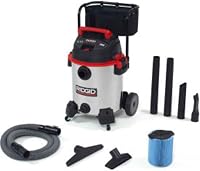
Craftsman CMXEVBE17595 16-Gallon Shop Vac Review: Worth It? (October 2026)
The Craftsman CMXEVBE17595 16-gallon shop vac suits recurring garage and workshop cleanup. Choose it for mixed wet and dry jobs; choose the CMXEVBE17607 if you also need a detachable blower.
On this page (9 sections)
- What does the Craftsman 16-gallon shop vac include?
- Who should buy the CMXEVBE17595, and who should skip it?
- Which CMXEVBE17595 specs matter before you order?
- How does the hose work around a car or bench?
- How does it compare with other 16-gallon shop vacs?
- How should you set it up for dry debris or water?
- What care keeps pickup consistent?
- Which common mistakes should you avoid?
- Should you choose this Craftsman 16-gallon shop vac?
The Craftsman CMXEVBE17595 16-gallon shop vac is a good fit for recurring garage and workshop cleanup, especially when your jobs include both dry debris and water. Its included nozzles cover floors, vehicle interiors and wet pickup.
Choose it when you have a permanent parking spot and enough open floor to move the drum. For small household spills or a car-only routine, a smaller vacuum is easier to store and carry.
What does the Craftsman 16-gallon shop vac include?
The CMXEVBE17595 includes the tools for general cleanup, car interiors and wet pickup, plus a filter and dust collection bag. You can start with those attachments and add specialty tools only when a job calls for them.
Craftsman CMXEVBE17595 16-Gallon Wet/Dry Shop Vac: Best for large garage cleanups

- 16-gallon drum
- 6.5 peak HP
- 7 ft Dual-Flex hose
- Built-in blower port
A practical choice for recurring garage cleanup, with wet, utility and car nozzles included. The oversized drain helps you empty collected water without lifting the full drum.
Pros
- Built-in blower port
- Oversized liquid drain
- Car, utility and wet nozzles included
- Three-year limited warranty
Cons
- Large canister needs floor space
- Requires repositioning beyond hose reach
- Blower remains attached to the vac
The package includes 2 extension wands, a utility nozzle, car nozzle, wet nozzle and Qwik Lock pleated paper filter. Onboard hose storage and organizers for the cord and accessories keep the kit together between jobs.
The utility nozzle suits open floors and work areas, while the car nozzle gives you another shape for seats and footwells. Use the wet nozzle for liquid pickup after preparing the tank and filter as directed.
Craftsman backs this model with a 3-year limited warranty. Keep your receipt and model number with the manual so replacement parts and coverage details are easy to find.
Who should buy the CMXEVBE17595, and who should skip it?
Buy this model for repeated cleanup in a garage or workshop, where a large drum can stay near the work. Skip it if most jobs involve carrying a vacuum upstairs or pulling it from a crowded closet.
It makes sense for collecting ordinary workshop debris after a project, cleaning garage floors and handling suitable nonhazardous liquid spills. Having one vac for those jobs saves you from trying to collect rough debris with a household vacuum.
A large drum is most useful when the mess has volume, such as wood shavings or scattered renovation debris. Small amounts of dust don't require a large tank, and filters still need attention even when the drum is nearly empty.
When is a Craftsman shop vac with a 16-gallon drum too large?
This size is too large when storage and carrying matter more than collection volume. A buyer cleaning one car in an apartment parking area has different needs from someone clearing a workshop floor each weekend.
Think about the whole route from storage to the mess: doorways, steps, parked cars and narrow gaps beside benches. A vac that fits its parking spot can still be awkward to bring out.
If you're choosing between sizes rather than brands, our complete shop vac buyer's guide explains the main categories and the jobs they suit.
Which CMXEVBE17595 specs matter before you order?
Use dimensions, empty weight and hose size to judge whether this vac fits your space and routine. Those measurements answer more practical questions than the motor label alone.
| Detail | Craftsman CMXEVBE17595 |
|---|---|
| Drum volume | 16 gallons |
| Motor rating | 6.5 peak HP |
| Amperage | 12 A |
| Hose | 2-1/2 in x 7 ft Dual-Flex |
| Dimensions | 21.03 x 23.8 x 26.7 in |
| Empty weight | 26 lb |
| Blower | Built-in rear blower port |
| Drain | Oversized built-in drain |
Drum volume is not usable pickup capacity. Debris shape, filter condition and the collection setup affect how much you can collect, so don't plan a liquid job around filling the whole drum.
Peak HP describes a peak motor measurement, not continuous cleaning power. Airflow and suction also matter, but the figures available here don't support an airflow ranking across all 4 models.
Read what CFM means on a shop vac if you're comparing airflow figures. Compare the same measurement across models rather than treating HP, CFM and suction as interchangeable numbers.
How does the hose work around a car or bench?
The included hose works best when you park the drum near the section you're cleaning. Plan several positions around a vehicle instead of expecting one parking spot to reach the whole cabin.
Dual-Flex connections provide 180-degree movement at both ends to resist kinking. That helps the hose bend near the drum and tool, but it doesn't replace having room to move the vacuum.
Keep the hose clear of sharp edges and avoid dragging it across painted panels. Move the vac by its handle rather than pulling it with the hose.
For a car interior, remove loose rubbish and floor mats first, then work from seats and crevices down to the floor. Our guide to using a shop vac to detail a car covers attachment choice and cleaning order.
Extension wands let you work on floors without bending as much. Inside a cabin, remove them and use the nozzle directly so you can control its angle.
How does it compare with other 16-gallon shop vacs?
Choose an alternative when its blower design, accessory fit or reach solves a specific problem. The CMXEVBE17595 remains the main choice here for buyers who want a straightforward garage cleanup kit.
Craftsman CMXEVBE17607: choose it for separate blower use
Craftsman CMXEVBE17607 16-Gallon Wet/Dry Vac: Best for garage and yard work

- 16-gallon drum
- 6.5 peak HP
- Detachable blower
- 7 ft Dual-Flex hose
Choose this Craftsman if your routine includes both collecting workshop debris and blowing leaves outdoors. Its detachable blower, crevice tool and locking blower wand make that mixed role its main advantage.
Pros
- Detachable blower
- POS-I-LOCK hose connection
- Crevice tool and blower wand included
- Three-year limited warranty
Cons
- Needs substantial storage space
- Same included hose length as the CMXEVBE17595
- Extra blower parts to organize
Choose the CMXEVBE17607 if you regularly switch from collecting shop debris to clearing leaves outside. Its detachable blower lets you leave the drum behind during blower work.
It also includes a crevice tool, locking blower wand and diffuser. The crevice tool matters for narrow gaps, while the blower wand supports its second role.
Skip this version if you rarely blow debris or would leave the extra tools unused. Its included hose has the same dimensions as the main Craftsman's, so this isn't a reach upgrade.
The decision is about how you'll use the blower, not a higher headline motor figure. Both Craftsman models share the same drum size and peak HP label.
Shop-Vac 8252605: consider it when replacing a Shop-Vac
Shop-Vac 8252605 16-Gallon Wet/Dry Vac: Best for existing Shop-Vac users

- 16-gallon drum
- 12 A
- Blower function
- Four wheels
An option for buyers replacing a Shop-Vac who want to check whether their current attachments can carry over. It provides wet and dry pickup, a rear blower port and onboard accessory storage.
Pros
- Wet and dry pickup
- Rear blower port
- Four wheels
- Onboard cord and accessory storage
Cons
- 12 ft cord calls for outlet planning
- Check accessory fit before reusing older tools
The Shop-Vac 8252605 is worth considering if you're replacing a Shop-Vac and want to check whether existing tools fit. Confirm connection sizes first rather than assuming accessories match because the brand is the same.
It has a 2.4 m hose, 12 ft power cord and onboard cord and accessory storage. Map those lengths against your outlet locations, especially if a workbench sits across the garage from the nearest socket.
Its rear port provides blower use while the motor remains with the drum. Skip it if your main reason for changing vacuums is to get a separate blower.
Before choosing it for a narrow task, confirm that the included nozzle set covers that job. The Craftsman kits provide a clearer starting choice here for buyers who specifically need car and wet nozzles.
Vacmaster VJH1612PF: choose it for workspace reach
Vacmaster VJH1612PF 16-Gallon Wet/Dry Vac: Best for spread-out work areas

- 16-gallon drum
- 145 CFM
- 27 ft cleaning reach
- Blower conversion
Consider the Vacmaster when outlet placement and moving between work areas shape your choice. It combines a padded push handle and wide-stance casters with onboard storage and 10 accessories.
Pros
- 27 ft combined cleaning reach
- 145 CFM airflow
- Large drain port
- Padded handle and wide-stance casters
Cons
- 35.4 in height needs storage clearance
- 25.8 lb empty weight matters on stairs
The Vacmaster suits buyers whose work areas are spread away from outlets. Its 27 ft combined cleaning reach includes the hose and power cord, so it doesn't mean you can reach that far from a parked drum.
It provides 145 CFM airflow, a padded push handle, wide-stance casters and a large drain port. Those features give it a clear role for someone moving a vac between open work areas.
The accessory kit includes cartridge and foam filters. Follow its manual when choosing between them for wet and dry work.
Skip it if your storage shelf or bench leaves little overhead clearance. At 35.4 in tall and 25.8 lb empty, it also deserves the same carrying-route check as the Craftsman.
For another brand comparison, read Ridgid vs Craftsman shop vacs. Our best 16-gallon shop vac guide covers more options in this size class.
How should you set it up for dry debris or water?
Prepare the filter, bag and tank for the material before switching on. Wet and dry pickup require different checks, even though they use the same drum.
Start dry cleanup with a clear hose and secure filter
Unplug the vac, check that the drum is empty and install the correct filter securely. Use a compatible collection bag when the manual calls for one and the material suits bag collection.
Connect the hose firmly, fit the right nozzle and check that the drain is closed. Clear large scraps by hand when they could block the nozzle or hose.
For repeated fine-dust work, choose filters and bags approved for that dust. A large tank alone doesn't make a vacuum suitable for hazardous dust or replace the collection system required by a power tool.
Change the collection setup before picking up water
Remove the dry collection bag and follow the manual's filter instructions before wet pickup. Keep electrical connections dry and use the vac only for liquids its manual allows.
Never collect fuel, solvents, hot ash or unknown chemicals. A wet/dry vacuum isn't a general-purpose solution for every spill.
Stop when the vac's full-tank shutoff activates, and empty sooner if moving the collected water would be difficult. The drain helps with emptying, but you still need a suitable disposal point.
Our guide to whether a shop vac can vacuum water explains the wet-pickup basics. For a broader setup sequence, see how to use a shop vac.
What care keeps pickup consistent?
Keep the filter clear, hose open and drum dry between jobs. A drop in pickup often calls for those checks before you consider replacing the vacuum.
Switch off and unplug it before opening the tank or clearing a blockage. Check the nozzle and hose first, then inspect the filter for packed debris or damage.
Follow the filter's cleaning directions rather than washing every cartridge. Let any washable part dry fully before putting it back into dry service.
After wet cleanup, drain the tank, remove residue and leave the parts to dry before storage. Damp debris left in a closed drum can create odors and make the next dry cleanup harder.
Use the onboard organizers without winding the cord tightly around sharp bends. Keep attachments together so the right nozzle is available when the next spill happens.
Which common mistakes should you avoid?
Avoid overfilling, using the wrong collection setup and blowing fine dust. These choices cause more trouble than choosing between similar headline motor figures.
- Waiting for a full drum: Heavy debris and water can become awkward to move well before the tank is full.
- Leaving the dry bag in for water: Prepare the vac for the new material before starting.
- Buying extra hose without checking fit: Match the connections and remember that longer hoses can reduce pickup.
- Blowing indoor dust around: Vacuum ordinary fine debris with the right filter instead of spreading it onto shelves and tools.
- Ignoring the filter because the tank is empty: A loaded filter can restrict airflow while there is still plenty of drum space.
Use the blower port for suitable loose leaves and grass clippings in an open area. Point the airflow away from people, vehicles and places where debris could get trapped.
Should you choose this Craftsman 16-gallon shop vac?
Choose the Craftsman CMXEVBE17595 16-gallon shop vac if you have room to keep it near recurring garage work and want a useful mix of cleanup nozzles. Measure its parking spot and plan where you'll empty liquids before ordering.
Pick the CMXEVBE17607 when a detachable blower earns its place in your routine. Choose the Shop-Vac after confirming accessory fit, or the Vacmaster when its combined reach and push handle address your workspace needs.
If carrying and storage remain the main obstacles, step down in size rather than forcing a large drum into your routine. Compare other sizes and formats in our shop vac picks.
Frequently asked questions
Is the Craftsman CMXEVBE17595 good for a garage?
Yes, it suits recurring garage cleanup involving floor debris, vehicle interiors and occasional water pickup; its included nozzles cover those different jobs without requiring the same tool for every surface. Choose a smaller vac if storage is tight or you mainly need quick cleanup inside a car.
Can the Craftsman CMXEVBE17595 pick up water?
Yes, it supports wet pickup and includes a wet nozzle and oversized drain. Unplug it before changing the collection setup, remove the dry dust bag and follow the manual's filter instructions; empty it before the tank becomes difficult to move, then clean and dry it before storage.
Does the Craftsman CMXEVBE17595 have a blower?
Yes, its rear blower port lets you direct exhaust air through the hose to move leaves and grass clippings; the blower stays with the vacuum body. Choose the CMXEVBE17607 if you want a detachable blower, and collect fine workshop dust rather than blowing it into the air.
How long is the Craftsman CMXEVBE17595 hose?
The included hose is 7 ft long and 2-1/2 in in diameter, with flexible connections at both ends. Plan to move the drum around a vehicle rather than stretching the hose across it; extension wands help with floors, but they don't add flexible reach inside a cabin.